Subscribe via your favourite podcast platform: Spotify | Apple Podcasts | Google Podcasts | Anchor | Breaker | Pocket Casts | RadioPublic
In this week’s episode:
- Diagnostics are shifting from reactive to predictive – Veterinary medicine is moving toward predicting disease before symptoms appear, using biomarkers like microRNA combined with AI.
- MicroRNA could be a game-changer across species – These newly understood molecules regulate gene expression and are conserved across animals, opening the door to more accurate, non-invasive diagnostics.
- Better diagnostics = better healthspan, not just lifespan – The real goal isn’t longer life, but better quality of life – giving vets clearer answers and more personalised treatment plans.
- The profession must adapt quickly to data and AI – Technology is advancing fast, and vets will need support, education, and confidence to stay ahead of increasingly informed clients.
A deep dive into how microRNA and AI are set to transform veterinary diagnostics, enabling a shift toward predictive, personalised care and better health outcomes.
Additional Guest Spotlights
- Next Episode Sneak Peak: Next episode, Jack is joined by Ellie Waldron and Ryan Norton, from MWI. we explore how trust in veterinary technology is built – from the practice floor to product design – and why getting it right is critical for teams, workflows, and patient care.
Show Notes
- Out every other week on your favourite podcast platform.
- Presented by Jack Peploe: Veterinary IT Expert, Certified Ethical Hacker, CEO of Veterinary IT Services and dog Dad to the adorable Puffin.
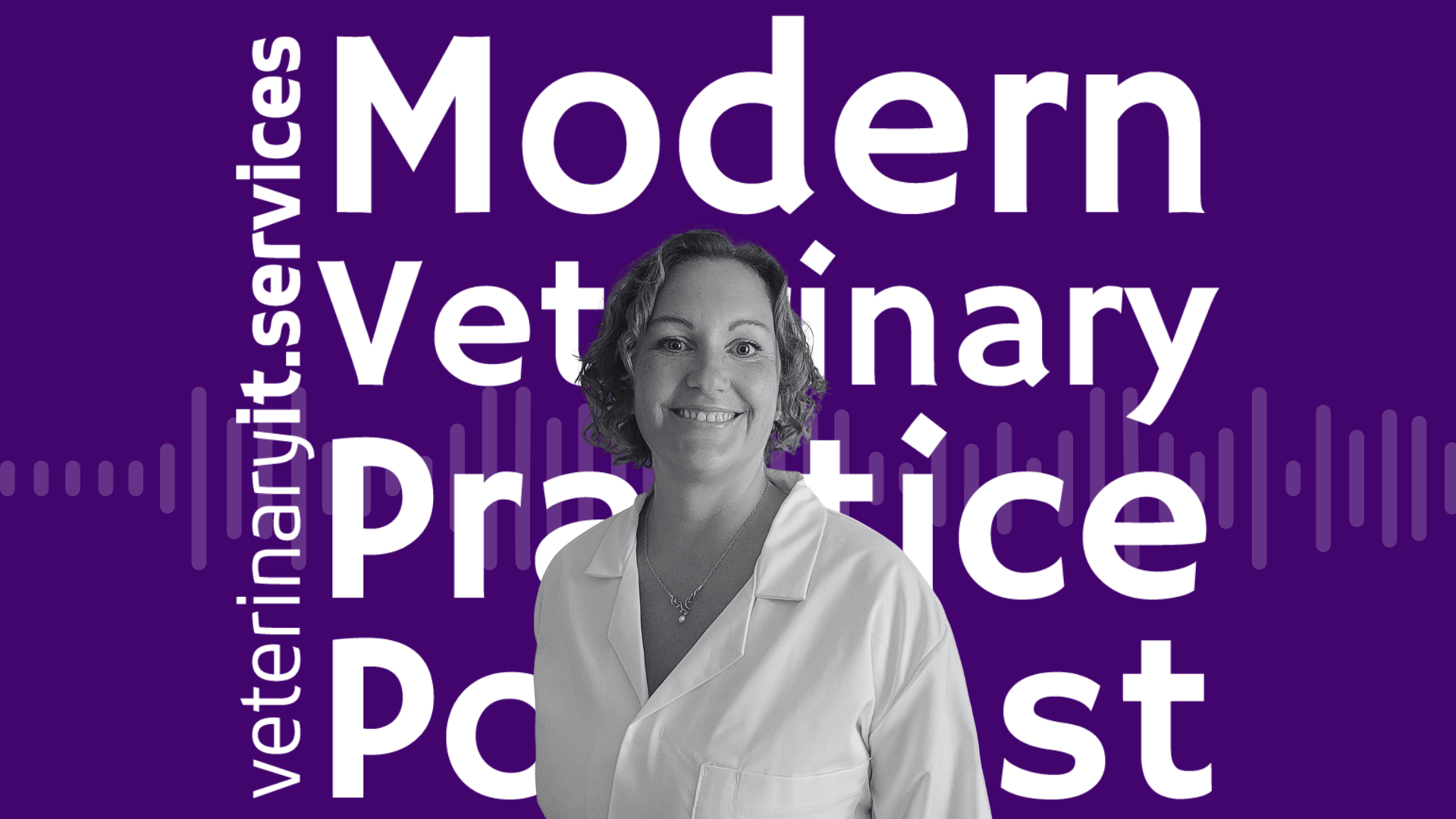
- Dr Eve Hanks is the CEO & Founder of MI:RNA. She has over 14 years of experience as a veterinary surgeon and is a thought leader in microRNAs having studied, researched and published in this area for 9 years, with a particular interest in host interactions in response to immune system challenges.
- Eve is an innovator and entrepreneur and she used her clinical background for conception, development and implementation of MI:RNA’s pioneering technology. As a solo female founder, she grew the business from the ground up after spinning out from Scotland’s Rural College, SRUC, and now leads a gender balanced team of experts, retaining overall responsibility for strategy, investment and fundraising, commercial roll out, networking and science education. In 2024, in recognition of her achievements, Eve received the ‘Impact’ award from the Royal College of Veterinary Surgeons in 2024, then in 2025 she was honoured with a fellowship.
- Find out more about MI:RNA Diagnostics here.
Transcription
Jack Peploe:
Coming up on Modern Veterinary Practice.
Dr Eve Hanks:
I think the world is more complex than science. It’s slightly more unpredictable, but I think that the science wouldn’t be anything without the world demanding the right questions or the right answers from the science. So I’m super passionate about the idea of not science for science safe, but science for change, science for advancement. And I think one of the best things around precision diagnostics, possible personalised medicine, moving into that prediction as we talked about combining modern biomarkers with the eye. One of the best things is that we can make a difference to health span.
Jack Peploe:
Welcome to the Modern Veterinary Practice Podcast. I’m your host and veterinary IT expert, Jack Peploe. In this episode, I’ll be welcoming Dr. Eve Hanks, veterinarian, clinical pathologist and CEO and founder of Mi:RNA Diagnostics to the podcast. We’ll be talking about how cutting edge science like microRNA and AI is transforming veterinary diagnostics, what the future of predictive and personalised medicine could look like, and how innovation can reshape the way we understand and treat disease in both animals and humans.
Dr Eve Hanks:
So I’m Dr. Eve Hanks. I’m the CEO and founder of Mi:RNA, and we are a new diagnostics testing company. We launched to use little pieces of RNA known as microRNA, and combine that with artificial intelligence to improve diagnostics for our production animals and our companion animals. And the reason for that for me, really, the reason I became involved in that was I was a veterinarian in practice for around about 13 years in Scotland, you can maybe tell by the accent. And I worked with horses, I worked with production animals, and I worked with our pets. And as I was doing that, I had a desire, I suppose, to continue with a bit more of the research side of things that I’d learned a little bit about at university. So I did an advanced certificate in medicine and a PhD in immunology. And when I was doing my PhD in immunology, I met for the first time micro RNAs and I was fascinated.
And so when I finished my PhD and started to work with a university in Scotland as a clinical pathologist, I didn’t want to let go of that part of my research that I’ve been working on. So I built that into a project within the university. And as a clinical pathologist, you get a really good overview of diagnostics. You’re working with everything that’s still alive, so clinical pathology as opposed to pathology, which is when things have already died, so it’s much cooler. And from that point of view, you’re looking at things like blood and urine samples, biopsies, but also things like disease outbreaks, for example, from farm to humans is interesting. And we do have a generally in human and in animal health, there is a big problem in terms of diagnostics that are accurate. So things like sensitivity, specificity, but also that can give us enough information for us to handle even a basic disease within a dog, cat, cow.
And actually we’ve all got our own experiences of this, of course, with our own pets or those of us who have been on farm, our own stables, we have experience of this. And I know people that are going through it just now where there’s a lot of unknowns even with advanced diagnostics, which often are quite invasive or require anaesthetics. So the whole idea, the driver behind me, I suppose, is to further research because I love science in general, but also to make enough of a difference in the field of diagnostics that we don’t sit wondering at the end of a phone for a vet to call us about news of a dog or cat, but that we know really within a short timeframe and accurately and precisely what’s actually happening. So that’s the mission.
Jack Peploe:
Awesome, Eve. Well, that sounds fantastic. And it is great to have you on the podcast. And I must say there’s something really special about that drive to not just work with science, but to actually apply it and bring it to the people who really need it, especially in the world of veterinary medicine. Now, I suppose for those who aren’t sort of deep in diagnostics, what’s something that’s surprising about microRNA that most people sort of overlook?
Dr Eve Hanks:
So when you first meet microRNAs, which some of us have done now, which is good, you have that, I’m sorry, what moment once you realise what they do, they’re just a part of the puzzle that we didn’t know. So the scientists who discovered microRNAs for the first time are Nobel Prize winners now, but they only got those prizes last year, at the end of last year. So we’re talking about hot off the press, cutting edge science. We’ve just worked these guys out and we understand now that microRNAs are like the project managers of our immune system. The thing that really got me was that we have this common ancestor. So around about 500 million years ago, microRNAs emerged and we have this common ancestor. So the microRNAs in my heart and my kidneys and my liver and my brain are the same as a dog and a cat and an elephant and a giraffe, et cetera.
So we have this wonderful conservation across species, which is amazing for veterinary research. But I think the other thing as well is that they act in so many different pathways so they can control genes, turn them on and off, which is really powerful for us not to have known that existed a few years ago. And they also can break down things like messenger RNA, they can act on their own molecular pathways too. So they really are responsible for how we respond to stress, whether that’s physiological, pathogen driven, et cetera. So really fundamental molecules in our body that we’ve only just discovered. So pretty cool stuff.
Jack Peploe:
That is really interesting. And where do you think we’re under utilising microRNA technology in veterinary or even human healthcare?
Dr Eve Hanks:
Well, we’re not using it yet. Right. Okay. So underused would be a really good underutilised were a really good phrase because we haven’t worked out how to fully use it in all instances yet. So at the moment, the state of play is that there are people researching microRNAs, including Mi:RNA and our team. But in terms of actually turning a new science into an applicable disease diagnostic in a clinic, whether that’s a hospital setting with humans or in the veterinary world, you need to go through a period of understanding the validation pathways and understanding exactly what happens. So if you imagine you’re trying to create a diagnostic for, let’s say, kidney disease, but then you have to check that works when you have a dog or a cat, when it’s chronic or acute, when they’re on medication or not, when they’re being fed something different or not.
So that pathway takes a little bit of time. So it’s just timing. We haven’t had enough time to be super clear. And then the other area we’re really underusing at the moment or underutilizing microRNAs is that in the human field, there is a lot of research looking at them as potential therapeutics. So they are not just diagnostic, but they actually change the course of a disease. So therefore you could give antisense microRNAs to a human to change the course of cancer or to a dog to change the course of arthritis or to a cat to change the course of kidney disease, but we haven’t started that yet. So that is so exciting as well.
Jack Peploe:
That’s incredible. And I mean, going into the diagnostic side, do you think diagnostics today are sort of too reactive and how close are we to predictive or even preventative care being the norm?
Dr Eve Hanks:
There are lots of cases where predictive and preventative care would help a lot, but there are also lots of cases where ethically or from a data point of view, it would also potentially throw up situations where we were wrong. So it’s important that as we evolve the science around diagnostics, that we make sure that the data captured is effective and not … We talk about pollution of data. So we have to make sure the data that we’re using to make those predictions is clear and clean. And then we also have to make sure it works in all instances. So a common example cited around precision or predictive medicine is in the human space where there are large sets of data, of course, from hospitals, but if you’re talking about the outcomes that the data pool will put together for, say, a middle-aged, middle-class man versus the outcomes that we’ll put together for a young, disadvantaged black, single mother, she will be at a disadvantage on the diagnostics.
So ethically, we are biassed as people inherently, the system is biassed. So therefore, believe it or not, the precision and prediction part of artificial intelligence is also biassed. So we need just a little bit of time to understand some of the issues where we may disadvantage patients by leaning into the prediction and prognosis side of AI without understanding what we’re actually feeding into the system.
Jack Peploe:
Right. Okay. And in relation to data, how do you see the role of data changing the relationship between vets and clients?
Dr Eve Hanks:
There’s lots of ways that’s already changed the relationship there. The obvious one is actually on the other side of the consult table. So clients come in and they’ve got more data. They understand ChatGPT is explained to them how kidney disease works and what food they could get, for example, before they come into a vet. So from a vet’s point of view, vets need the data now to try to stay that step ahead of a client. And I know that there’s upsides to that, there’s downsides to educated clients. I prefer it because they’re on the journey with you. I prefer that they’re dialled in and they understand the risks of ingestion of a sock and a dog or something like that, as opposed to before where it seemed very difficult to explain why a surgery may be needed, et cetera. And so I think it’s a positive move forward, but if, for example, you’re a vet and you’ve never heard of micro RNAs and someone comes in and says, “I want a microRNA test for this dog’s heart disease,” you’re going to be on the back foot.
So how do we help and make sure that vets and veterinary professionals are as up-to-date as possible in some of the new data areas? And that’s something that I think the whole industry is asking itself just now.
Jack Peploe:
Right. Okay. Now I want to sort of flip this slightly and look at your background in the fact of setting up my RNA, the entrepreneurship side. One of the question I had for you was, what’s harder solving a complex scientific problem or convincing the world it’s worth solving?
Dr Eve Hanks:
I think the world is more complex than science. It’s slightly more unpredictable, but I think that the science wouldn’t be anything without the world demanding the right questions or the right answers from the science. So I’m super passionate about the idea of not science for science sake, but science for change, science for advancement. And I think one of the best things around precision diagnostics, possible personalised medicine, moving into that prediction as we talked about combining modern biomarkers with AI. One of the best things is that we can make a difference to health span, and we’ve found the world is more interested in health spans. So just to unpack that a little bit, lifespan is obviously always important to humans and to animals, but as we’ve increased that in both cohorts, what we have found is that lifespan and production animals fit in here too is not actually the end goal, but when we think about things like welfare, enjoying what life we have, spending more quality time together, it’s health span that’s more important to the world.
So we could unpack the science and increase the time that dogs live, the time that cows live. Nobody wants that. They want better health in their pets and better time together.
Jack Peploe:
No, that makes complete sense. Now, you’ve obviously walked the path as a solo female founder in science. What’s one thing you’d tell the next generation of female innovators?
Dr Eve Hanks:
There isn’t actually one answer to that. I think I would lean towards saying, “Just do it. It’s great, but it’s not great.” I want women to enter the space more than they are or stay in the space, but the reality is that there are challenges, and that’s not just for women. There are challenges for all entrepreneurs. So this is not the easiest job in the world, but it’s one of the jobs where personally I’ve had the most growth. I’ve had the most incredible journey in the last six years as founder initially. So that in itself was a shock to the system. And then from that transition between being a founder in a science field through to being the CEO of a team and leading the charge on that has been, again, another shock. And I’m sure my post-entrepreneurial world, when I’m perhaps not founder and CEO of my army and whatever I’m doing next, will also be a shock.
So I think it unlocks a lot of … It opens so many doors, it unlocks a lot of power that you … And I mean that in a positive and personal power way where you really grow into a role and you can really enjoy it. So that’s the positives. Negatives are that when you’re on a growth journey like that, it’s super uncomfortable, it’s emotional, there’s sacrifices to be made. There are parts of that journey where you genuinely just want to get in your car and drive away, start a new life in Canada or something. So I think from that point of view, I want to be realistic, but there is a lot of support and there are a lot of amazing people around you when you’re in the founder and startup space in general. So it’s worth it in my eyes, but it’s not utopia.
Jack Peploe:
I love to work out what it is. Now, on the science side, obviously that has quite a number of risks and startups do too. How do you personally manage the tension between scientific rigour and commercial urgency?
Dr Eve Hanks:
By not having commercial urgency, so you just need patient capital. So when you’re bringing on investment, you need to make it super clear that this is a new science. Things go wrong in the lab, often in a hilarious fashion on a Friday afternoon, just enough to give you a sleepless weekend. So yeah, there are challenges. And I think there are a lot of startups that have raised on a revenue ramp. So they’re saying, “Hey, invest in us. And over the next one, two, three years, we’re going to be bringing in $50 million per quarter or whatever. It’s just not our style.” So I think from that point of view, it’s not that we don’t have, we’re seriously commercial at Mi:RNA. We’re serious about taking this to market, but we’re taking it to market with the whole supply chain at a cadence that makes sense and makes the science credible and gives us that opportunity to educate the end user as well.
So from that point of view, I think that’s the message that I find most useful and people and the investor community that resonates with them as well. It’s a brand new area of science. There’s no way we could get it to you to market in a year. So let’s just be very honest about that and how we will fund that company going forward and part of that will be investments. So I think you’re right, Jack. There is a tension, but there’s always a tension in a company, but there’s also a responsibility to do things in a way that is going to further science and further or improve, we hope, the lives of vets and pets, but in its own time and when it’s ready, when it’s ready.
Jack Peploe:
No, that makes complete sense. And talking about the future, you’ve obviously got a foot in science and a foot in clinical reality. What do you think vets in practice will need most over the next 10 years?
Dr Eve Hanks:
10 years a long time. It’s a long time at the moment, isn’t it? So when we think about artificial intelligence changing everything, are what is a vet in practice going to look like in 10 years time with AI, clinical pathologists, AI-based diagnostics, which obviously my area, practice management systems that listen to with a microphone, cameras, observing all the ICU or emergency patients and taking their temperatures remotely and all this sort of thing. So honestly, I think vets in practice now need a lot of support because the job that is changing under their feet all of the time. And I don’t think the industry’s preparing for that really at all. So I mean, even if you look at the implementation of telehealth and video medicine, there was resistance just to that. And that’s the most simple of the changes that’s going to come past the vet’s store in the next two to three years, nevermind, 10 years.
So I think the job’s going to change so radically. There’ll be pockets of the old style, but the job will change really radically. So I think letting go of a bit of nostalgia and stepping into the future for the benefit of the patient is the way forward. So what they need, I think, is support, really literally emotional support to get through that change. And we could therefore perhaps expect some of our corporate veterinary chains and some of our management within vets to be ahead of that curve a little bit. And I would really encourage people to, who are managing vets to really start to think about how they implement that technology, how they support their staff as they do so.
Jack Peploe:
Yeah, no, I completely agree. And if you could redesign the diagnostic experience in a typical veterinary consult, what would that look like?
Dr Eve Hanks:
Probably happened before the consult would be good. So the vet would like just generally. I think there’s a lot that can be done at home and sent into a lab, for example. And speed isn’t really necessarily a thing for wellness testing, but certainly for illness testing, it’d be great to know more. And I would love to cut out therefore that anxious weight at the end and instead have everything a bit more streamlined. But realistically, what I would love most of all, regardless of when you get the results, is to have a really personalised plan for afterwards. So that for me is the key to diagnostics. So saying, little Jimmy, the terrier does in fact have kidney disease or heart disease, but we know that his type of heart disease is really stable, so we don’t need to start medication and we don’t need to check you again, but for a year at least.
So enjoy your time. There is a little bit of early heart disease, but it’s not clinically significant. And that in itself, what a relief instead of people waiting six months to find out a bit more and is it progressive or not? So just that angst that comes with a diagnostic would be amazing to take out of the picture.
Jack Peploe:
Yeah, no, absolutely. And I mean, you’ve mentioned human healthcare a number of times. Do you think the next big diagnostic breakthrough will come from inside veterinary medicine or from another sector entirely?
Dr Eve Hanks:
I think we’re all … I mean, one health is such a buzzword, but I think we are all starting to work together a bit more. And I know that things like when we talk about antimicrobial resistance or new diagnostics or new therapies, that there isn’t as much of a divide between veterinary and human and the science side. Often a veterinary model for, say, cardiac disease is a dog and a human’s model for cardiac disease is a dog. So there’s a lot of data there from both sides of the fence that use animal models to understand disease. So I think from that point of view, we can look at this as a mammals project. I think once we build in the data, sharing a little bit more in the big data part of medicine. So however, I think typically we have different diseases that bother us more.
So in the human field, when we’re talking about cancer, Alzheimer’s, depression, anxiety, the diagnostics there are likely to come from the human field. So chronic pain, chronic depression, anxiety we tend not to focus on in the dog and cat sector as much. And then similarly, if we’re talking about things like mastitis and cows, I think that’s going to come from the cow side, from production animal. So I think the data and the background is being shared better, but the actual spinoff diagnostics are going to be species specific, I think.
Jack Peploe:
No, absolutely. Well, Dasu, it’s been a really incredible … To get your peak behind the scenes at the science and the mindset driving your work. And it’s a really fascinating topic, but I can’t believe it is that time already, which is just incredibly frustrating because I could chat for ages. For those people who want to get in touch with you, how can they go about doing so? I
Dr Eve Hanks:
Think best thing for us, our newly new launch of our website, our nearly newly launched website is coming through. So we are Mi:RNA-diagnostics.com, but also we’re super active on LinkedIn. And if it’s a in- person meet, so we literally love speaking to vets, veterinary professionals industry about this whole project. So LinkedIn is the perfect way to get in touch with us as a team or me individually.
Jack Peploe:
Fantastic. And all that being the show notes, but thank you so much for your time today. It’s been a really, really interesting session, so thank you.
Dr Eve Hanks:
Thanks for having me. Recommended resources.
Jack Peploe:
Every episode, we ask professionals and experts to suggest a best business resource for our listeners. This week’s recommendation is from Alice Hendy.
Alice Hendy:
So firstly, Matt Hage, I would recommend following him on social media, really amazing, inspirational person. He’s gone through real battles himself firsthand. He’s got lived experience of depression, of anxiety, and so on. And he’s got a book called Stay Alive. It’s really open. It’s really honest. It’s frank. It doesn’t preach, but it gives you real information and guidance if you’re struggling and if you’re finding things difficult. And actually, when I lost Josh, it was of real comfort to me to read some of the words that he’s put in that. He’s got a few books, but as I say, he’s also really active on social media, so he’s an inspiration to me and one that I would recommend.
Jack Peploe:
Coming up next week, we welcome Ellie Waldron, registered veterinary nurse and customer product consultant manager and Ryan Norton, product lead at NWI Animal Health. Ellie and Ryan bring two powerful perspectives, life on the practice floor and the world of product design to explore what trust in veterinary technology really looks like. We dive into the realities of practice management systems, why so many teams feel overwhelmed by tech, and how better design, training and communication can transform daily workflows. They also share practical insights on reducing admin burden, improving team efficiency, and ensuring technology supports rather than hinders clinical care.
Ellie Waldron:
When I used to go into practice, I didn’t think about … I didn’t know what a practice management system was. I didn’t care what a practice management system was. I just put my trust in the vets and the nurses that they were giving me all the information and the advice and the care that I needed. And then when I went into practice as a nurse, I was like, “Oh, okay. So this is what our practice management system does. It’s more than just taking notes.” And I was learning more about why vets use a practice management system and how much we relied on it. And as a pet owner, I didn’t think about any of that. I just trusted the vets and the vets then need to trust their practice management system so that the pet owners can trust them, if you know what I mean.
It’s kind of like the trust passes on.
Jack Peploe:
That’s it for this episode. All links and recommendations we talked about are in the show notes. Don’t forget to subscribe and share the podcast if you found it useful. In the meantime, thanks for listening and see you next time.